Apple brings a fully revamped Siri built on Google's Gemini, but not to the EU
A major consumer AI development: Apple deploying a rebuilt, context-aware Siri powered by
AI 日报
这期日报从 34 条资讯中筛选出 9 条重点 AI 新闻。 关注主题集中在 apple、ai-training、ai-infrastructure。 如果只先读两条,可以从 《Apple brings a fully revamped Siri built on Google's Gemini, but not to the EU》、《iOS 27 is finally here, with the new Siri AI beta - and 120 security patches - ZDNET》 开始。
Overview
从 34 条资讯中筛选出 9 条
这期日报从 34 条资讯中筛选出 9 条重点 AI 新闻。 关注主题集中在 apple、ai-training、ai-infrastructure。 如果只先读两条,可以从 《Apple brings a fully revamped Siri built on Google's Gemini, but not to the EU》、《iOS 27 is finally here, with the new Siri AI beta - and 120 security patches - ZDNET》 开始。
A major consumer AI development: Apple deploying a rebuilt, context-aware Siri powered by
A major Apple platform release introducing next-generation Siri AI, broad user-facing changes,
This is an important development in web governance and AI infrastructure because it introduces
A consequential, quantitatively grounded analysis of whether hyperscalers can justify nearly $1.
Stories
The Decoder

Apple has launched a beta of its Gemini-powered Siri with on-device and cloud processing, personal and screen context, and cross-app actions, but it is initially unavailable in the EU and China.
A major consumer AI development: Apple deploying a rebuilt, context-aware Siri powered by Google's Gemini could significantly affect mobile assistants and the competitive AI landscape. Its beta status, reported reliability issues, and limited regional availability temper the impact; no community comments were provided to assess discussion quality.
Apple brings a fully revamped Siri built on Google's Gemini, but not to the EU Key Points - After years of delay, Apple has released the new version of Siri as a beta. It runs on Google's Gemini models and processes data partly on the device, partly through a cloud. - The assistant can read screen content and personal context from messages or photos, and carry out tasks across different apps. - Early tests praise practical improvements but fault ongoing misunderstandings. The service won't launch in the EU and China for now. After several delays, Apple is shipping its overhauled Siri.
ZDNET AI

Apple has released iOS 27 and related OS updates, adding new features, AI-powered Siri capabilities, performance improvements, and a large set of security patches.
A major Apple platform release introducing next-generation Siri AI, broad user-facing changes, and approximately 120 security patches makes this highly relevant to software, mobile, and AI audiences. The security fixes and integration of conversational AI are particularly significant, though the article provides limited technical depth and no comment discussion is provided.
ZDNET’s key takeaways - Apple has launched new OS 27 versions for the iPhone and other products. - Also released were 26.7 versions for the iPhone, iPad, and Mac. - Both OS versions add new features and a host of security patches. Monday was a busy update day for Apple. Not only did the company roll out iOS 27, but it also pushed out an update to iOS 26 for users sticking with the old OS. After months of beta testing, iOS 27 is now Apple’s official iPhone operating system, with a variety of new and improved features.
Cloudflare AI

Cloudflare is launching a setting that allows websites to block AI training by mixed-use crawlers while remaining indexed in search, with Apple, Google, and Microsoft supporting or committing to support the control.
This is an important development in web governance and AI infrastructure because it introduces a mechanism for site owners to remain searchable while opting out of AI training, with commitments from major search and technology companies. It could influence crawler standards and content licensing, though the announcement is primarily a platform policy feature rather than a fundamental technical breakthrough. No comments or discussion were provided to assess community debate.
Without proper controls, website owners have long faced a difficult tradeoff: allow your content to be used for AI training, or risk losing discoverability in search. That tradeoff exists because some of the largest organizations on the Internet use mixed-use crawlers: a single crawler serving both search and AI training. Refuse one, and you refuse the other. Today, Cloudflare is announcing a new Disallow AI Training setting that lets you easily stay indexed for search while refusing to let that same crawler train on your content.
MIT Technology Review AI

The article examines how much hyperscalers' productivity and earnings must grow for their enormous AI data-center investments to generate an acceptable return by 2030.
A consequential, quantitatively grounded analysis of whether hyperscalers can justify nearly $1.1 trillion in AI infrastructure spending, offering a useful break-even framework amid uncertainty about adoption and model value. The estimated 2.7x productivity requirement is notable for investors and the AI industry, though the excerpt is incomplete and no community discussion is provided.
When Jessica Wachter, a finance professor at the University of Pennsylvania’s Wharton School, wanted to assess AI’s impact on the economy over the next few years, she faced a long list of business and technical uncertainties. So she started with what she calls a “remarkable fact” that is not in question: A handful of so-called hyperscalers are investing huge amounts of money to build AI data centers. Instead of trying to predict how useful and widely deployed AI models will be, she simply asked how fast the hyperscalers’ earnings will need to grow to justify their spending through 2027, when—she and her…
TechCrunch AI

AIUC, founded by former Anthropic and METR leaders, raised $40 million to develop enterprise AI safety and underwriting tools aimed at preventing autonomous agents from behaving dangerously.
The article describes a notable AI safety startup founded by an early Anthropic employee and former METR COO, along with a substantial $40 million Series A and early enterprise customers. Its focus on controlling autonomous AI agents is highly relevant to AI governance and deployment, though the claims appear largely company-driven and the provided content includes no substantive comment discussion to validate or challenge them.
A day after Anthropic researcher Jacob Coxon quit his job over concerns that AI could kill us all by the end of the decade, I met with founders and brothers-in-law Rune Kvist and Rajiv Dattani. They think they have a solution that could save us all, or at least help prevent AI agents from going rogue inside enterprises. “AI is getting smarter at an increasingly rapid rate. The surprising thing about AI is that it becomes harder to adopt and harder to control as AI gets smarter, not easier,” said Kvist, an early Anthropic employee who is also married to Dattani’s sister).
TechCrunch AI

Salesforce and Nvidia introduced Koa, an open-weight reasoning model specialized for sales, marketing, and customer support that aims to offer enterprises greater privacy, lower costs, and task-specific performance than general-purpose frontier models.
This is a high-value industry development because it illustrates a significant shift toward open-weight, domain-specific enterprise models optimized for privacy, cost, and practical business workflows rather than general frontier performance. The collaboration between Salesforce and Nvidia could influence how enterprises deploy AI and compete with closed-model providers. No comments or discussion are provided, so community validation and debate cannot be assessed.
A new AI model called Koa is one of the biggest announcements from Salesforce this week at its giant Dreamforce tech conference. Koa is the company’s first reasoning model, built on Nvidia’s open-weight Nemotron model. The two companies worked together to post-train Koa to excel at sales, marketing, and customer-support-related tasks. Koa is a shining example of how the enterprise world’s needs for AI are diverging from what the frontier labs are offering.
The Decoder
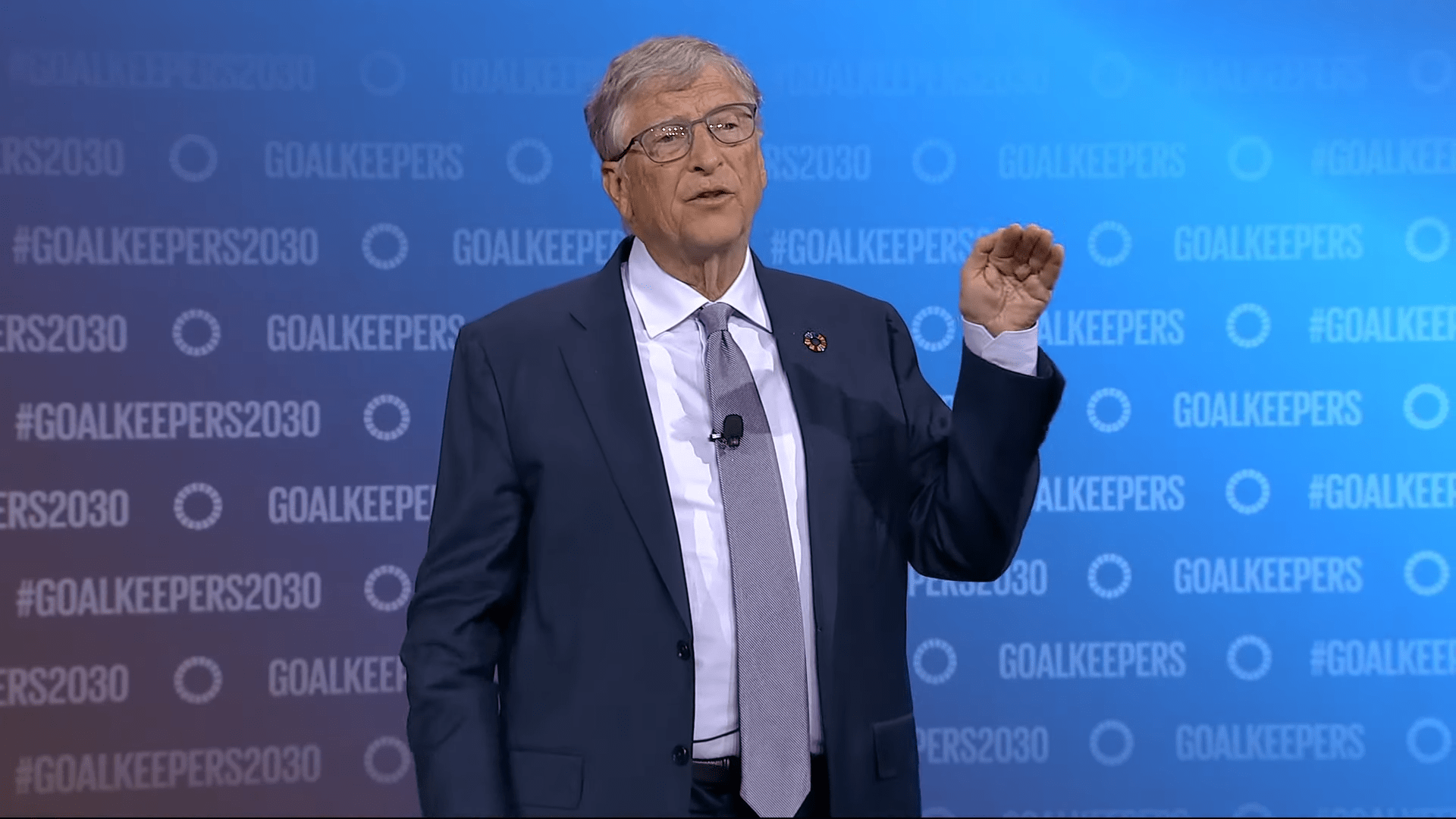
The Gates Foundation plans to invest at least $1 billion over two years to expand equitable AI access in developing regions through non-English data and applications in health, education, and agriculture.
This is a high-value AI policy and philanthropy announcement with potentially significant implications for global health, education, agriculture, and equitable access to AI, especially through support for non-English data and regional applications. However, it is primarily an investment and strategy announcement rather than a technical breakthrough, and no discussion or comment quality is provided.
After warning AI is too dangerous, Bill Gates bets a billion on its upside Key Points - The Gates Foundation is investing at least a billion dollars over two years to make AI tools more widely available in health, education, and agriculture. - Bill Gates warns of a growing gap between rich and poor, since common language models are built on more than 90 percent English data and neglect poorer regions. - The money will go toward opening up non-English data sources and funding real-world projects, including diagnostic aids in Kenya, learning systems in Sierra Leone, and digital farming advice in India.
The Decoder

Agility Robotics announced Digit 5, a humanoid warehouse robot designed to operate near people without safety fences while offering higher lifting capacity, faster charging, and modular grippers.
A significant robotics industry announcement introducing improved payload, charging, runtime, and human-safe operation for warehouse deployment, with potential implications for industrial automation; however, the claims are primarily company-reported and no comment discussion is provided.
Agility Robotics says its new Digit 5 robot can work next to people without safety fences Agility Robotics has unveiled Digit 5, the next version of its humanoid robot for warehouses and factories. The robot can now work alongside people without safety fences. It spots people using AI and sensors and, according to the company, stops or steps aside. It also gives off visual and audio signals to warn anyone nearby. Agility is the first partner for Nvidia's Halos safety platform for robotics. Digit 4 was the first humanoid robot to pass an independent OSHA safety review on a production line, Agility says.
The Verge AI

SimpliSafe has launched a $199.99 AI-enabled video doorbell that allows paid monitoring agents to remotely observe and verbally deter suspected intruders or package thieves.
This is a moderately significant consumer-security product launch combining on-device AI, cloud computer vision, facial recognition, and human-in-the-loop intervention. It raises relevant questions about proactive surveillance, privacy, reliability, and recurring service costs, but is primarily a commercial product announcement rather than a major technical breakthrough. No comments or discussion quality information was provided.
DIY home security company SimpliSafe is bringing its AI-powered proactive security feature to the front door. The new SimpliSafe Video Doorbell Series 2 launches today for $199.99 and works with the company’s Active Guard Outdoor Protection (starting at $49.99 a month). This combines AI analysis with live agents to detect potential threats and respond proactively. When the camera detects suspicious activity — using a combination of on-device AI, cloud-based computer vision, and facial recognition — a SimpliSafe monitoring agent can drop in on the camera to “see, speak to, and attempt to deter potential intruders…