Texas halts data center connections to power grid amid overwhelming demand
This is a high-impact policy development affecting AI infrastructure, electricity planning,
AI 日报
这期日报从 57 条资讯中筛选出 25 条重点 AI 新闻。 关注主题集中在 ai-infrastructure、cloudflare、ai-agents。 如果只先读两条,可以从 《Texas halts data center connections to power grid amid overwhelming demand》、《Announcing Cloudflare Wallets: The programmable wallet for the agentic Internet》 开始。
Overview
从 57 条资讯中筛选出 25 条
这期日报从 57 条资讯中筛选出 25 条重点 AI 新闻。 关注主题集中在 ai-infrastructure、cloudflare、ai-agents。 如果只先读两条,可以从 《Texas halts data center connections to power grid amid overwhelming demand》、《Announcing Cloudflare Wallets: The programmable wallet for the agentic Internet》 开始。
This is a high-impact policy development affecting AI infrastructure, electricity planning,
This is a noteworthy industry announcement from Cloudflare introducing a programmable wallet
This is a high-value platform announcement from Cloudflare introducing CI/CD execution on its
High-value engineering case study from Cloudflare on applying AI agents to open-source issue
Stories
Ars Technica AI
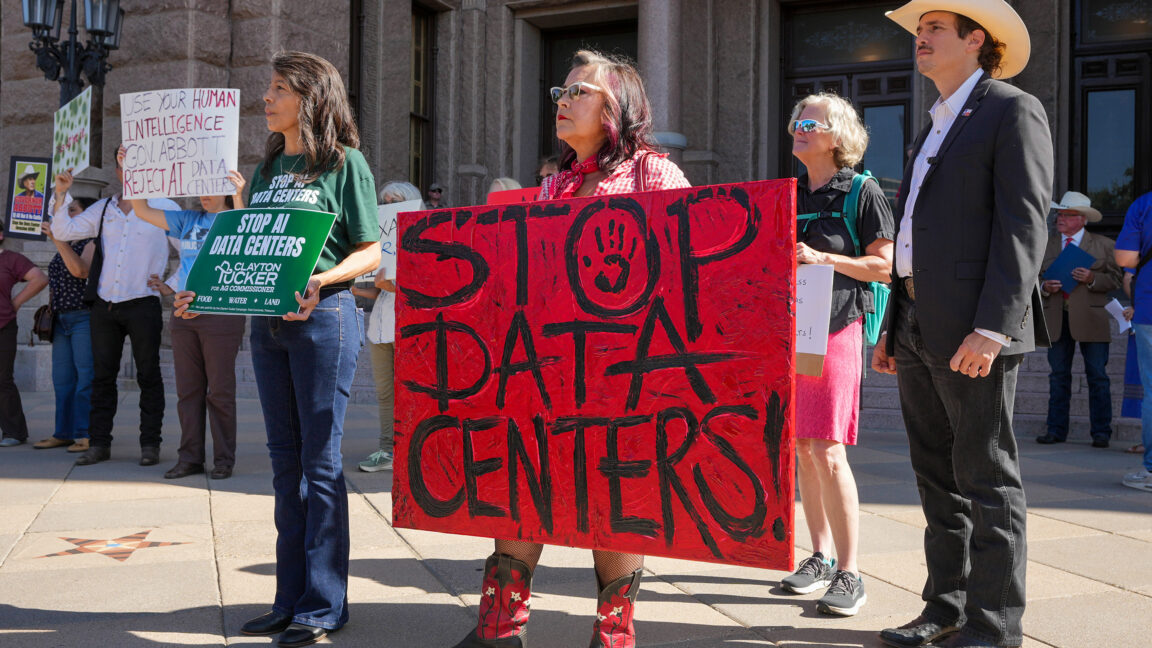
Texas has paused new data center grid connections while regulators audit projects amid concerns that rapid AI-driven development is overwhelming the state’s power infrastructure and affecting communities.
This is a high-impact policy development affecting AI infrastructure, electricity planning, data center expansion, and grid reliability in a major US technology hub. The moratorium could materially reshape data center deployment and highlights escalating tensions between AI growth and energy capacity. No comments or discussion quality information was provided.
Nowhere is the US data center boom bigger than in Texas. But less than a year after declaring Texas the “epicenter of AI development,” Governor Greg Abbott has declared a moratorium on all new power grid connections for data centers—at least until developers provide more information about their projects’ potential impacts on the grid and communities. The Republican governor directed regulators in an August 3 announcement at the Public Utility Commission of Texas and the grid operators at the Electric Reliability Council of Texas (ERCOT) to perform a “comprehensive verification and audit of all data centers…
Cloudflare AI

Cloudflare announces Wallets, a programmable wallet and unique handle system designed to help AI agents sign up for and pay for APIs more autonomously.
This is a noteworthy industry announcement from Cloudflare introducing a programmable wallet concept aimed at enabling AI agents to identify themselves and pay for APIs, which could meaningfully lower friction for agentic commerce. The post appears substantive and relevant to AI infrastructure and web payments; no comments/discussion were provided to assess community reaction.
Today, it is difficult for AI agents to try out new APIs. They often have to navigate through a login page designed for humans and not agents, contact a human to add a payment method, generate an API key, and then figure out how to call the API. This flow is very difficult for agents for two reasons: Agents do not have a stable identifier to sign up for an API, and they do not have a native way to pay for APIs. Because they lack these things, they often struggle to onboard onto software, which limits the growth of agentic commerce.
Cloudflare AI

Cloudflare announces a CI/CD workflow system that lets developers store, build, test, and deploy code on Cloudflare at scale, using Workflows, the CI SDK, and Artifacts.
This is a high-value platform announcement from Cloudflare introducing CI/CD execution on its infrastructure, built on Workflows and integrated with Artifacts for large-scale repo management. It has strong relevance to cloud platforms and developer tooling, though the content is primarily a product announcement rather than a deep technical research breakthrough; no comments were provided to assess discussion quality.
We are moving toward a world in which you can store, build, test, and deploy your code fully on Cloudflare. We built the first piece with Artifacts, versioned code storage that scales to millions of repos. We have stitched the store, build, and deploy steps together with the CI SDK, built on Cloudflare Workflows, so that you can run your continuous integration (CI) pipeline on Cloudflare. You can send artifact push events directly to your Workflow, triggering an instance of its execution — a CI job, essentially — through a new events field in your wrangler configuration file.
Cloudflare AI

Cloudflare describes an automated AI-driven issue-triage pipeline for Astro that aims to reduce maintainer burden and has reportedly driven the repository’s GitHub issue count to zero.
High-value engineering case study from Cloudflare on applying AI agents to open-source issue triage with claimed real operational impact (driving Astro’s issue count to zero). It is relevant to software engineering and AI automation, with likely strong practical interest even though the excerpt is mostly introductory and no comments are provided to gauge discussion quality.
Everyone is talking about software factories: the idea that AI agents can be assembled into a pipeline that produces working software on their own, the way a factory turns raw materials into finished goods. There’s endless debate over whether that’s actually possible, how far the automation can really go, and whether the “loops” people are demoing count for anything. Some have already written them off as a failure. Running alongside that is a quieter, more worried conversation: open source maintainers are burning out.
TechCrunch AI

A SaferAI evaluation suggests China’s open-weight GLM-5.2 is nearing leading models in cyber and biological capabilities but lacks comparable refusal behavior and safety controls.
High-value analysis of a consequential trend: open-weight models may be approaching frontier capabilities while exhibiting substantially weaker safeguards on offensive cyber and dual-use biology tasks. The findings have important implications for AI governance, model release practices, and misuse risk, though the evidence is based on a single nonprofit evaluation and no comments or discussion are provided.
As policymakers debate how to govern increasingly powerful AI systems like OpenAI’s GPT-5.6 Sol and Anthropic’s Mythos, a Chinese open-weight model has narrowed the gap with the industry’s leaders. GLM-5.2, the open-weight AI model from China’s Z.ai, is only a few months behind OpenAI’s GPT-5.5 and Anthropic’s Claude Opus 4.7 on cyber and bio capabilities, according to a new report from AI safety nonprofit SaferAI. But the divide between frontier capabilities and safety practices is growing. According to SaferAI’s evaluation, which the nonprofit ran via Z.ai’s public API, GLM-5.
TechCrunch AI

Anthropic reportedly signed a six-year, $10 billion cloud-compute deal with Volta, backed by Bitdeer and Nvidia infrastructure, for a 133-megawatt AI data center in Norway.
A reported $10 billion, six-year compute agreement would be highly significant for AI infrastructure, Anthropic's scaling strategy, and the emerging GPU cloud market. However, the report relies partly on anonymous sources and lacks full confirmation; no comments or discussion quality information was provided.
Anthropic has been on a cloud partnership spree in recent months, and its latest move is reportedly a $10 billion deal with AI cloud startup Volta. Bloomberg originally reported that Volta, founded earlier this year, will provide cloud compute to the Claude maker over a six-year period. Volta has a partner in this deal, Bitdeer, a crypto-mining company that will help develop the data center to provide the compute capacity. That facility will be located in Norway and will deliver a 133 megawatt capacity. It will be fueled by Nvidia’s Vera Rubin systems, the chipmaker’s state-of-the-art AI chip architecture.
TechCrunch AI

Texas is requiring audits for all new data center projects after ERCOT's connection queue more than doubled to 474 gigawatts, with about 90% attributed to data centers.
High-value policy and infrastructure development: Texas pausing new data center projects for PUCT and ERCOT audits highlights mounting grid constraints caused largely by rapidly expanding AI and cloud computing demand. No comments or discussion quality were provided.
Tech companies and developers have been scouring the U.S. for places to build data centers, and they’ve been drawn to Texas’ loose regulations and seemingly abundant power supply. Only Virginia hosts more data centers than Texas. But even Texas can be pushed to the brink. Governor Greg Abbott announced Monday that all new data center projects will need to be audited by both the Public Utility Commission of Texas (PUCT) and the state’s grid operator, the Electric Reliability Council of Texas (ERCOT). The size of ERCOT’s interconnection queue has grown dramatically this year.
TechCrunch AI

Apple is escalating its trade secrets lawsuit against OpenAI and related parties, alleging more former employees may have been involved in taking confidential data tied to AI device development.
High-impact legal and industry news involving Apple, OpenAI, and alleged trade secret misuse; relevant to AI hardware strategy and talent mobility. No comments were provided to assess discussion quality.
Apple is now seeking a preliminary injunction in its trade secrets case against OpenAI, which aims to stop the AI model maker from moving forward with developing an AI device or other products based on Apple’s technology. The iPhone maker also claims that more of its former employees may be involved with the trade secrets theft. In a new filing, Apple is requesting expedited discovery from the accused OpenAI employees, senior systems engineer Chang Liu and Chief Hardware Officer Tang Yew Tan; OpenAI, and its foundation; and io, the device startup co-founded by Apple’s former lead designer Jony Ive.
The Decoder

Google is using a complex, off-balance-sheet financing arrangement to provide Anthropic with up to $35 billion in TPU infrastructure while spreading substantial financial and infrastructure risk across partners and investors.
High-value analysis of an unusually large AI infrastructure financing structure involving Google, Anthropic, Broadcom, major financial institutions, and crypto-mining capacity providers. It highlights systemic financial and operational risks tied to Anthropic's growth, though the content is primarily reported analysis rather than a confirmed technology breakthrough.
Google moves billions in Anthropic chip risk off its balance sheet Key Points - Google has set up an elaborate financing structure with Broadcom and Morgan Stanley to give AI startup Anthropic access to $35 billion worth of Google's proprietary AI chips, known as TPUs. - Because none of the companies involved want the hardware on their books, a special-purpose vehicle was created to buy the chips with outside investor money; Broadcom serves as guarantor, and Anthropic leases the hardware.
Cloudflare AI

Cloudflare describes how it uses AI code and design reviewers, backed by a centralized engineering Codex, to enforce standards and reduce time spent searching for guidance.
This is a high-value engineering operations post about using AI to enforce coding and design standards at scale, with concrete adoption metrics (250k violations flagged, 16k merges blocked, 600 designs reviewed). It’s not a scientific breakthrough, but it offers practical insight into AI-assisted developer workflows and governance. No comments were provided to assess discussion quality.
Over the past four months, our AI code reviewer has flagged nearly a quarter of a million deviations from Cloudflare engineering standards (what we’ll call “violations” in this post) and blocked 16,000 merges. Our spec reviewer agent has evaluated close to 600 technical designs against the same standards before implementation began. Both systems draw from the Cloudflare Codex, a shared source of engineering guidance built for people and agents. This post explains why we built the Codex, how it supports the engineering lifecycle, and what we plan to do next.
Cloudflare AI

Cloudflare Agents is a new platform offering for deploying and managing hosted AI agents, starting with agent tracing and observability.
Cloudflare is launching a notable new platform capability for deploying and observing AI agents, which is highly relevant to developer infrastructure and agent tooling. The announcement has meaningful product significance, though it is primarily a platform feature update rather than a research breakthrough; no comments/discussion were provided.
We're bringing together everything you need to deploy and manage hosted agents on Cloudflare, starting with observability. We've spent the last nine years building a developer platform, and agents are the perfect use case. They're really just another type of application, but what you need to build them — model access, durable runtime, orchestration, sandboxed execution, persistent storage — happens to be exactly what we've already built. Now, we’re making it even easier to deploy and manage your agents on Cloudflare.
OpenAI News
OpenAI describes recent third-party cybersecurity evaluation incidents and announces strengthened safeguards for testing its models.
This is a high-value update on cybersecurity testing of AI models and the safeguards needed to improve third-party evaluations, with implications for AI safety and responsible deployment; no comment discussion was provided to assess.
OpenAI explains recent third-party cybersecurity evaluation incidents and outlines new safeguards to strengthen AI model testing and evaluation.
Simon Willison

PipeNetwork's minimax-h3-mlx package makes the MiniMax-H3 multimodal video-generation model runnable on Apple Silicon through MLX.
A valuable technical release that ports the newly released MiniMax-H3 multimodal video-generation model to MLX, enabling local inference on Apple Silicon Macs; it is particularly relevant to developers exploring efficient local AI, though no discussion or comments were provided to assess community response.
<p><strong><a href="https://github.com/PipeNetwork/minimax-h3-mlx">PipeNetwork/minimax-h3-mlx</a></strong></p> MiniMax released <a href="https://huggingface.co/MiniMaxAI/MiniMax-H3">MiniMax-H3</a> two days ago - they describe it as a "a general-purpose, omni-modal generative system", which in practice means it accepts text, images, audio and video and can use them to generate up to 15 second video clips with audio included.</p> <p>This Python package ports it to MLX for running on Apple Silicon.</p> <p>I got it running on my M5 Max MacBook Pro.
TechCrunch AI

Nvidia-led Open Secure AI Alliance has quickly formed a working group proposing open guidelines for confidential AI security incident reporting and collaborative analysis.
This reports a potentially important early industry effort to standardize AI cybersecurity incident reporting and share open-source security technologies, with participation from over 120 companies and Linux Foundation coordination. The proposals are still preliminary and described as non-groundbreaking, and no comment discussion is provided to assess community validation.
The week-old Open Secure AI Alliance (OSAA), an industry group spearheaded by Nvidia that has already grown to over 120 companies, has developed a cutely named working group, the Shared AI Findings Exchange, or SAFE. The group is already presenting proposals for open comment, and the Linux Foundation, a member of the group, is managing the proposals. The group developed them while members gathered at the nexus of the cybersecurity world, the Black Hat conference, taking place this week in Las Vegas. The guidelines are nothing terribly earth-shattering for now.
The Decoder

A record eight Pulitzer recipients and finalists disclosed using AI tools for tasks such as searching documents, translation, and classification, reflecting growing acceptance of carefully supervised newsroom AI use.
This is a high-value indicator of mainstream journalism's evolving, increasingly transparent use of AI for document analysis, translation, and verification. It highlights practical newsroom applications and institutional acceptance, though it reports adoption trends rather than a major technical breakthrough; no comments or discussion were provided.
This year's Pulitzer Prizes saw a record number of winners disclose AI use A record eight Pulitzer awardees disclosed using AI this year, including five winners and three finalists, Nieman Lab reports. Disclosures have been required since 2024. This year, entrants used AI tools and large language models more often, mainly to search large document sets faster. The Wall Street Journal used an internal LLM to summarize thousands of public documents on Texas floods. The Minnesota Star Tribune used ChatGPT to translate a female shooter's diary written in faux Cyrillic, then had language experts check the results.
The Verge AI

·#amd
AMD’s AI-driven data center revenue surged to $6.7 billion in Q2 2026, offsetting a 31% decline in gaming revenue and making data center operations 58% of total sales.
A significant industry development showing AI demand reshaping AMD’s business, with data center revenue more than doubling year over year and becoming the company’s dominant segment, while gaming declines amid pricing and supply pressures. The report is primarily financial rather than a technical breakthrough, and no comments or discussion quality are provided.
Driven by demand for AI capacity, AMD’s data center revenue more than doubled year-over-year in its latest earnings report, reaching $6.7 billion. That’s up from $5.8 billion in Q1, and jumping 107 percent from the $3.2 billion it reported for the same period a year ago. At the same time, AMD’s gaming revenue fell 31 percent compared to last year, to $779 million, as price hikes and component shortages slowed sales for the Xbox Series X / S, PS5, and Valve’s Steam Deck. [Image: https://platform.theverge.com/wp-content/uploads/sites/2/2026/08/amd-q2-2026-earnings-slides-screenshot.png?
The Verge AI

The article argues that unhealthy reliance on LLMs may be more widespread than public debate acknowledges, using Hank Green’s AI controversy to examine psychological, ethical, and credibility concerns.
The article explores an important and underexamined aspect of generative AI: psychologically unhealthy dependence outside extreme clinical cases, alongside concerns about misinformation, authenticity, and attribution. It is socially and ethically relevant, though it appears primarily analytical rather than presenting new research or definitive evidence; no comments or discussion quality were provided.
Hank Green, a popular YouTuber and science communicator, said he is stepping back from production amid intense criticism over his use of AI. Green described his AI usage as “not healthy,” but stressed that he used it for finding research sources and not to write scripts. Much of the ensuing firestorm in this corner of the internet has centered on how a creator can square a brand built on authenticity and credibility with a technology trained on the (often uncompensated) works of others, and which has a well-known tendency to generate plausible-sounding falsehoods.
WIRED AI
%20China-Free%20Robot.jpg)
The article examines how robotics startup Ati developed largely China-independent hardware and how tightening US restrictions on Chinese advanced robotics could affect the industry.
Provides useful analysis of robotics hardware supply-chain independence, US-China technology restrictions, and the strategic tradeoffs of vertically integrated design. It is relevant to robotics and industrial technology, though the excerpt is incomplete and does not present a major technical breakthrough; no comments or discussion quality were provided.
Investment in robotics startups hit record highs this year, both in the number of deals and dollars invested, according to PitchBook, which tracks venture capital flows. But many of those companies primarily develop software, and they largely still rely on Chinese suppliers for their hardware. The Federal Communications Commission’s decision to ban new models of human-like robots, known as humanoids, and other advanced devices from China could hamper the growth of many smaller robotics firms in the US. But some businesses could benefit, including Ati.
ZDNET AI

The article argues that AI is surfacing security vulnerabilities faster than organizations can fix them, forcing enterprise security teams to rethink their response and triage processes.
The piece covers an important and timely security trend: AI-assisted vulnerability discovery is outpacing remediation capacity, which has real implications for enterprise defense and software supply chains. It appears to be a commentary/news analysis article rather than original research, but the topic is highly relevant and likely useful for security and engineering teams; no comments or discussion signals were provided.
Follow ZDNET: Add us as a preferred source on Google.ZDNET's key takeawaysAI-discovered security problems are growing like a tidal wave.Whether using a PC or running a data center, everyone will be affected.We are not ready for what's coming.The good news is that AI is finding security holes faster than ever. The bad news is that AI is finding security holes faster than ever. It's both: While it's great that we're finding all those bugs, trying to fix them all is a monster of a job.
Cloudflare AI

Cloudflare argues that AI has accelerated implementation so much that teams need a new agent-focused development lifecycle to manage the downstream impact on software delivery.
A timely industry blog post from Cloudflare discussing the emerging "Agent Development Lifecycle" and how AI-driven code generation is changing software delivery. It is relevant and thoughtful, but appears more conceptual and promotional than a major technical breakthrough; no comments or discussion quality were provided to boost its score.
Engineering managers spent the past few decades figuring out ways for many programmers to work together on a shared codebase. This work dates all the way back to the “Systems Development Lifecycle” (RAND, 1975) - today commonly referred to as the “Software Development Lifecycle” (SDLC), which defines the following phases: - Plan - Design - Implement - Test - Deploy - Maintain - Retire AI has made the step that was previously the slowest and most expensive — implementation — the fastest and cheapest.
Simon Willison
Steve Yegge describes how Opus 4.7 introduced a persistent "just two more things" behavior that caused Gas Town to fail by endlessly tweaking itself instead of converging on useful work.
A notable quote from Steve Yegge about coding agents and model behavior, but it is primarily commentary rather than a substantial technical announcement. No discussion/comments are provided, so there is no evidence of community debate or validation beyond the cited quote.
<blockquote cite="https://yegge.ai/essays/the-shape-of-things-to-come/"><p><a href="https://yegge.ai/gastown.html">Gas Town</a> was intended to be reusable, but I only ever wound up using it to build itself. Gas Town fell apart at the seams with Opus 4.7. Up through 4.6 it was working brilliantly. With 4.7 we saw the introduction of the "just two more things" tic, which prevented Opus from ever converging on being ready to do real work—it always wanted to fiddle with Gas Town itself. The Opus tic never went away, so Gas Town effectively burned down. It had other problems, too, but 4.7 was the final straw.
Simon Willison
The post advises people to treat AI output as input to review and understand rather than blindly forwarding it to others.
A concise but useful observation about responsible AI use and the importance of human verification, understanding, and authorship. It offers practical guidance but limited technical depth, and no comments or discussion are provided.
3rd August 2026 - Link Blog Don't be a meat proxy ( via ) Niklas Gruhn coins an excellent new term - meat proxy - for people who blindly copy and paste the output of AI systems to their peers. By all means, prompt AI. But don't just relay the output. Read it, understand it, validate it, and then write a response in your own words (a decent certificate that you've done the prior steps). Making that effort is value you can add. By all means, prompt AI. But don't just relay the output.
TechCrunch AI

TechCrunch and Hudson Labs analyze seven years of Tesla earnings calls to show Elon Musk increasingly emphasizing AI, Optimus robots, and robotaxis despite cars remaining the company’s main business and revenue source.
A useful data-driven analysis of Tesla’s strategic messaging shift toward AI, robotics, and autonomy, though it primarily examines executive rhetoric rather than presenting a major technical breakthrough or definitive business transformation. No comments or discussion quality information was provided.
Elon Musk wants you to believe Tesla is no longer a car company, even if it’s still shaped like one. The company shipped nearly half a million cars last quarter and made 70% of its money from car sales. Still, Musk has spent the last few years making the case that Tesla is really an AI and robotics company, even if some of the AI happens to live in cars. And whatever the company financials suggest, Musk’s attention has been moving decisively to the AI parts of the company — projects like the Optimus robot and fully autonomous robotaxis — as the everyday concerns of a carmaker get pushed to the side.
The Decoder

OpenAI responded to Apple's trade-secret lawsuit by publishing chat logs it says show Apple employees continued requesting technical information from former engineer Chang Liu after his departure.
This is a notable legal and corporate development involving two major technology companies and allegations of trade-secret misuse, with potentially important implications for AI hiring and information-security practices. However, it remains an adversarial claims exchange rather than a confirmed technical breakthrough, and no comment discussion was provided.
OpenAI fires back at Apple's trade secret lawsuit with chat logs showing Apple employees kept texting their former colleague OpenAI is pushing back against Apple's trade secret lawsuit and has released chat messages that it says show Apple employees themselves reached out to their former colleague Chang Liu for technical information. In a blog post, OpenAI accused the iPhone maker of taking a sloppy and unnecessarily aggressive approach.
The Verge AI

Texas is requiring audits of new data center proposals before they can connect to the state grid, adding scrutiny around power, water use, incentives, and community impacts.
This is a notable policy development for data center infrastructure and grid access in Texas, with potential implications for AI and cloud expansion, but it is more of a regulatory update than a major breakthrough. No comments were provided to assess discussion quality.
Texas announced new a audit on data centers that could slow approval for new facilities seeking to connect to the state energy grid. Governor Greg Abbott (R) on Monday directed the Public Utility Commission of Texas (PUCT) and the Electric Reliability Council of Texas (ERCOT) to verify and audit new data center proposals, writing that the review is needed to “keep the grid stable and reliable.” Data centers will need to provide information on state and local incentives they’ve received, how much they’d rely on the state grid, expected water consumption and sources, and how they plan to track community impacts…