Mistral AI raises 3 billion euros in Europe's largest-ever tech funding round despite lagging behind rivals
This is a major industry announcement: Mistral AI closed a record-breaking 3 billion euro
AI 日报
这期日报从 34 条资讯中筛选出 10 条重点 AI 新闻。 关注主题集中在 mistral-ai、ai-for-biology、semiconductors。 如果只先读两条,可以从 《Mistral AI raises 3 billion euros in Europe's largest-ever tech funding round despite lagging behind rivals》、《Google’s Atlas of the human genome could pave the way for new treatments》 开始。
Overview
从 34 条资讯中筛选出 10 条
这期日报从 34 条资讯中筛选出 10 条重点 AI 新闻。 关注主题集中在 mistral-ai、ai-for-biology、semiconductors。 如果只先读两条,可以从 《Mistral AI raises 3 billion euros in Europe's largest-ever tech funding round despite lagging behind rivals》、《Google’s Atlas of the human genome could pave the way for new treatments》 开始。
This is a major industry announcement: Mistral AI closed a record-breaking 3 billion euro
Google DeepMind’s AlphaGenome Atlas appears to be a major AI-for-biology announcement with
Important semiconductor industry update: ASML securing adoption of High-NA EUV from TSMC,
This is a timely and technically relevant operational issue about abusive web crawlers
Stories
The Decoder

Mistral AI raised 3 billion euros in a record-setting European tech funding round, boosting its valuation to over 21 billion euros despite lagging behind some competitors in model performance.
This is a major industry announcement: Mistral AI closed a record-breaking 3 billion euro Series D, becoming the largest-ever European tech funding round and signaling strong investor confidence in frontier AI infrastructure. The news is highly relevant to AI and tech funding, though the note that Mistral trails rivals tempers the technical impact. No comments/discussion were provided.
Mistral AI raises 3 billion euros in Europe's largest-ever tech funding round despite lagging behind rivals Three years after launch, Mistral AI has closed a 3 billion euro Series D round, pushing its valuation past 21 billion euros. According to Mistral, it's the largest equity funding round any European tech company has ever raised. Samsung Electronics is leading the round, with the Scaleup Europe Fund (managed by EQT) and PSG Equity joining as co-leads. New investors include Advent, funds managed by BlackRock, and the Grand Duchy of Luxembourg.
The Verge AI

Google DeepMind has launched AlphaGenome Atlas, an AI-based predictive map of human genome variants aimed at accelerating biological research and enabling new disease treatments.
Google DeepMind’s AlphaGenome Atlas appears to be a major AI-for-biology announcement with potential impact on genomics research and disease treatment discovery. The content suggests broad scientific significance rather than a minor product update, though no community discussion or external validation is provided.
Google DeepMind has unveiled an AI tool that its scientists claim could help unravel the mysteries of the human genome and transform our understanding of biology, accelerating scientific research and ultimately paving the way for new treatments for diseases. The platform, called AlphaGenome Atlas, contains a “predictive map of every possible DNA letter change in the human genome,” the researchers said in a blog post published on Tuesday.
The Decoder
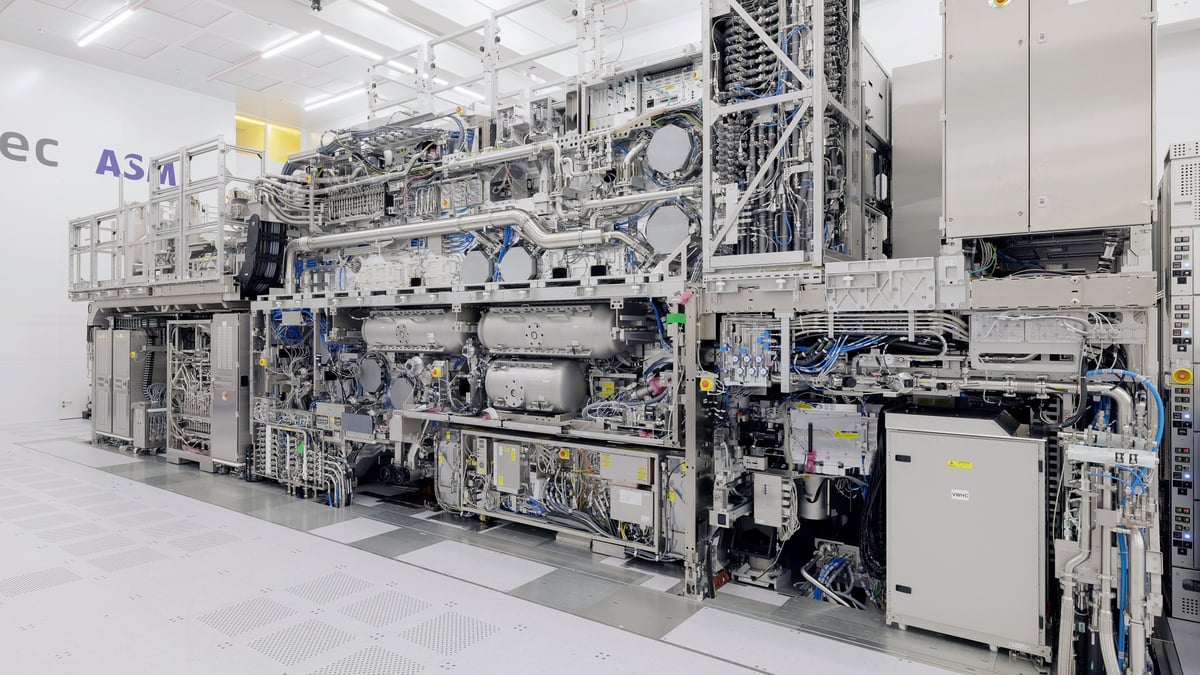
ASML has secured commitments from major chipmakers to adopt its High-NA EUV lithography tools while China, led by Huawei, pushes to reduce dependence on ASML.
Important semiconductor industry update: ASML securing adoption of High-NA EUV from TSMC, Samsung, and Intel has major implications for advanced AI chip manufacturing and supply-chain strategy. The piece appears to be a concise news report rather than a deep technical analysis, and no comments/discussion are provided to assess community debate quality.
ASML locks in TSMC, Samsung, and Intel while Huawei races to break its grip EUV lithography is one of the most critical bottlenecks in building the most advanced AI chips. As ASML lines up its biggest customers behind its latest tech, China is trying to break its dependence on the Dutch company under Huawei's lead. ASML has won commitments from the leading chipmakers to adopt its newest production tech, according to a report from Bloomberg. Samsung plans to use the Dutch company's High-NA EUV lithography machines for high-volume manufacturing starting in 2028, and TSMC in 2030.
Simon Willison
The post highlights how abusive crawlers are now consuming more CPU at git.kernel.org than legitimate users, raising broader concerns for crawlable web services like Datasette.
This is a timely and technically relevant operational issue about abusive web crawlers consuming disproportionate infrastructure resources on git.kernel.org. It has clear implications for web publishing, crawling policy, and systems cost management, though it is more of an insightful industry observation than a breakthrough; no comment discussion was provided to assess community debate quality.
7th September 2026 - Link Blog Creepy crawlies ( via ) Konstantin Ryabitsev discusses how bad the "background radiation" of abusive crawlers has become from the perspective of git.kernel.org , the official Git repository for the Linux kernel: TL;DR: we spend more CPU cycles rendering commits for scrapers than we spend on all other kinds of legitimate access, including git clones. At any one time, across 5 geo-distributed nodes, there are 14 CPU cores doing nothing but rendering git commits as html.
Simon Willison
Jakub Pachocki argues that faster progress on smarter models is justified to build aligned defensive AI for securing infrastructure and countering rogue agents.
This is a notable strategic quote from OpenAI's Jakub Pachocki about the need for powerful aligned AI as a defensive measure against other AI systems. It is more of a perspective/commentary piece than a technical breakthrough, and no comment discussion is provided to assess community debate or validation.
7th September 2026 The strongest argument I see for continuing to train much smarter models quickly is the need to build defensive systems against the dangers posed by other AI. [...] We will need powerful, aligned AI for defense; to secure infrastructure, to protect against rogue agents in real time, and to invent entirely new protective measures. This will be a primary focus of OpenAI’s deployment efforts. At the same time, even with the uncertainty that comes from anticipated broad AI progress and the need to build defensive systems, we must not let that become an excuse for recklessness.
The Verge AI

Adobe is adding in-timeline generative AI tools to Premiere, letting editors create video and audio assets without leaving their editing workflow.
This is a notable product update for a widely used professional tool: Adobe is integrating multi-model generative AI directly into Premiere’s timeline, which improves workflow and reflects the growing maturation of AI-assisted creative software. No comments were provided, so discussion quality cannot be assessed.
Adobe is overhauling how editors interact with AI in its Premiere professional video editing software. Its new Generative Media tool makes it easier to generate video, sound effects, music, and soundscapes without ever leaving the project timeline. The generators themselves aren’t entirely new; the big change is how easily you can access them without breaking your workflow. Instead of jumping between browsers or external apps to find missing B-roll or audio elements, editors can now highlight an empty gap on the video or audio track and generate context-aware, fully editable clips without leaving the project.
MIT Technology Review AI

The article profiles Danijar Hafner’s stealth startup building AI agents and humanoid robots designed to plan and adapt to unexpected, unseen real-world situations.
This is an interesting profile of a stealth AI robotics startup focused on agents that can generalize to unseen environments, which is relevant to embodied AI and robotics. However, it reads more like a feature story than a major technical announcement, and no comments or discussion quality are provided.
Danijar Hafner’s office in San Francisco’s SoMa district sits mostly empty. His brand-new startup is still in stealth mode and doesn’t even have its name on the door. On the day I visit, there’s only one other person there, and little in the way of furniture. But what it lacks in decor, it makes up for in robots. Humanoids of various shapes and sizes hang like marionettes from racks that run down the center of the wide-open space.
OpenAI News
OpenAI highlights how increasingly capable and affordable AI could expand what people and businesses can do while lowering the cost of growth.
An official OpenAI announcement about more capable and affordable AI is relevant to AI/ML practitioners and industry watchers, but the provided blurb is high-level marketing rather than a technical or research-focused release. No discussion comments were provided to assess community debate or validation.
Explore how more capable, affordable AI can expand the work people and businesses can accomplish—and make growth more economical.
The Decoder

Argentina's Patagonia is emerging as a potential hub for large AI data centers thanks to abundant land, cool climate, and access to diverse energy sources, with several projects already being discussed.
Relevant industry news about emerging AI data center infrastructure and energy siting in Argentina, but it is still mostly a regional development and market update rather than a major breakthrough. No comments/discussion were provided to assess community debate or validation.
Patagonia has what AI data centers want, including no resistance so far Argentina's Patagonia is drawing attention as a possible site for large AI data centers. A cool climate, hydropower, wind energy, shale gas from the Vaca Muerta formation, and plenty of empty land are the draw, according to a Reuters report. Power producer Pampa Energía plans a facility of up to 500 megawatts in Neuquén province and is looking for investors, with the first contracts expected by the end of 2026. Interested parties want to start with 20 to 40 megawatts.
The Decoder

Meta is removing AI usage from engineer performance reviews after employees began overusing AI tools to game metrics, while the company prepares tighter cost controls and continues testing its AI agent tools.
This is a notable internal policy shift at Meta showing how incentive design around AI can backfire, but it is more of an operational/organizational update than a major technical breakthrough. The article appears to be based on reporting rather than primary technical detail, and no comments or discussion quality were provided.
Meta drops AI usage from engineer performance reviews after "tokenmaxxing" backfires Meta will no longer judge its engineers by how much they use AI tools. AI dashboards and token counters won't factor into performance reviews anymore, executives Maher Saba and Santosh Janardhan said in an internal memo seen by The Information. What counts now is the quality, speed, and complexity of the work. Meta had previously made AI use a review criterion, which led to what people started calling "tokenmaxxing." Employees burned through AI tokens in bulk just to look good on internal leaderboards.